Why is it that Iran Can Challenge US Imperialism?

Today, the world is gripped by the events surrounding the treacherous, barbaric war of US imperialism and its scheming Israeli dependency against the nation of Iran. Moreover, they are shocked by the fierce endurance of the Iranian state and people to weather the heaviest blows of the most technologically advanced and reactionary imperialist power on earth, while striking powerful blows of its own. How can it be that a relatively weak nation without a strong economy, navy and air-force can win strategic battles against such a fierce opponent?
It is because of these two facts:
(1) Reactionaries are paper tigers;
(2) It is the force of the people themselves, not this or that special weapon that decide victory.
Reactionaries Are Paper Tigers
The US is the hegemon of world imperialism. Since the conclusion of WWII, which saw the rest of the capitalist world in ruins, US monopoly capitalism has acted as CEO to the capitalist-imperialist order—reorganizing and revitalizing it through economic and military discipline; massively enriching itself while cohering world imperialism and the relations of production that it depends on, (that is, the super-exploitation of oppressed nations by imperialist nations) against any external or internal threats. For a long time, an acute external threat existed in the USSR and the growing communist and anti-colonial camp emerging out of the weakness created by world imperialism’s internal tendencies towards crisis, resulting in a series of global economic catastrophes and the devastation of two world wars. While the post-war arrangement provided some relief to the material community of capital and resumed expanded reproduction on an ever greater scale, this situation went on to extend and deepen the great crisis within the imperialist system due to the failure of this new arrangement to overcome the tendency of the rate of profit to fall. Paired with this is the phenomena of: (1) the increasing organic composition of capital (a greater concentration of machinery, as opposed to living labor, which reduces the absolute magnitude of surplus value and lowers the value of labor, precluding the possibility of consuming all the products which capitalism creates, i.e. value realization) and (2) the compounding concentration and centralization of capital in the new structures of multilateral-imperialism, which have been adapted to fit the post-war collapse of the prior inter-war monopoly capitalist structures. This tendency was further compounded by the spread of the revolutionary camp closing vast portions of the world to capital markets.
Later, with the double blow from the capitulation of China and collapse of the USSR to capitalist roaders, new vistas of power and domination opened up for US-led world imperialism to seize, saving it from an acute period of deepening economic crises. This defeat of the two main pillars of the communist world movement extended the life of dying world imperialism and catastrophically weakened the position of the small socialist states and non-aligned nations of the world, leaving billions to the mercy of transnational finance capitalist.
Triumphant imperialism, with its new lease on life, proclaimed the end of history with the US as the undisputed ruler of world affairs. With decadent confidence Yankee-led imperialism exported its production onto the heads of the oppressed nations, greatly increased the revenues of rentier finance capital, and dumped vast amounts of the new profits it obtained through this arrangement into a titanic military production apparatus, attacking and suppressing the proletariat of the oppressed and imperialist nations in one fell swoop. But despite the fresh injections of profits and orgiastic pillage undertaken, capitalism’s inescapable problem of the falling rate of profit reasserted itself and economic crises continued to emerge from the contradictions at the heart of production itself. Yet again, new markets needed to be smashed open and re-ordered for profitable investment, cheap labor and raw materials. The US needed to invent new enemies to maintain world imperialism and its place atop it.
The 21st century has largely centered around two interlinked phenomena; kinetic and economic wars to control West Asia’s productive and logistical capacity primarily in fossil-fuels on the one hand, and the two poles of imperialism emerging out of the uni-polar moment following the end of the cold-war on the other. US led world imperialism has waged aggressive campaigns to dominate the Gulf region, and West Asia broadly, for decades but has largely come away with little success in achieving goals that advance its position. Certainly, horrendous destruction costing millions of lives and untold misery for the people of these nations has been accomplished, but through every measure to coerce, dominate or destroy the people lessons were also taught on how to endure, resist and, in time, effectively fight back. Rather than alleviate the crisis of imperialism these steps have only worked to compound and intensify it to astronomic new levels.
This state of affairs has left the US deeply entrenched in the management of its West Asian interests—bogged down and distracted from other developments. The stagnating occupation had sat largely untested for many years and has continued to invest in the hyper-expensive military technologies and tactics that were effective in fighting insurgent forces and armies 20 to 30 years their technological inferior. Legacy air dominance and naval power were heavily emphasized by Washington planners, themselves deeply integrated within the capitalist war cartels who profit from the monopoly on producing advanced killing-machines, not from the agile planning and strategic thinking required for an effective industry for fighting war. In short, the thinking, technology, and tactics all began to stagnate under the decadence of monopoly capitalism and the classic hubris of colonialism.
Resting on the assumption that its own foundations were unshakable and that any challenge could be brought to its knees through overwhelming force, the US became ever more prone to strategic flights of fancy and delusional appraisals of the conditions.
On the other hand, China, having fully opened itself up to world imperialism after the defeat of socialist construction by the capitalist roaders concentrated around Deng Xiaoping, themselves simply expressions of material forces emerging out of the contradictions of the socialist construction period, has developed fully fledged monopoly capitalism with a vast productive capacity and capital exports to rival all the big powers. From being subjugated by international monopoly capital once again, under the revisionists it has emerged steadily as the near equal of the US in global influence and economic might. China is able to wield capital to subjugate the oppressed nations to its developmental interests alongside the US, Japan, Germany, and the UK, etc.,—even finding itself in the position to eat up large portions of the big powers’ foreign market shares, and forcing concessions from them at home—breaking away large parts of the semi-colonial world from the old powers to serve the interests of Chinese capital, developing competitive technologies in key sectors, and shaking the order of world imperialism itself. It is both competitor and compliment to the other imperialist nations and fully participates in, if not props up, multilateral monopoly-capitalism. Though the PRC retains some artifacts of the socialist development period, principally through the state’s ability to command and discipline its capitalist class (not to mention its proletariat), and is dovish in comparison to US imperialism while directing a larger share of imperial super profits towards internal development and civil society, it is clear that monopoly capital plays the principal role in the composition of the state and economy, and thus a decisive influence on class character of the state. Despite their waving of the red flag and appealing to the revolutionary period, which under scrutiny betrays a bourgeois nationalist character divorced from proletarian internationalism (one need simply review China’s involvement in Congo and Madagascar to ‘break the window paper’ of their mutually beneficial international development rhetoric), Chinese monopoly capital functions according to the same laws as all monopoly capital: overproduced capital in need of profitable sites of investment tending towards crisis; the main driver of modern imperialism.
This astronomical rise of the PRC to a pole position in world imperialism is both a result and cause of the US's flagging position atop the bourgeois heap. When, in 2008, China was one of the main world powers bailing out the capitalist system from its grand crisis through massive purchases of US debt (rising from 414.2b in 2007 to its peak of 1.3 trillion in 2013) and stimulus projects1, it was clear that though the US still retained its hegemonic status, a qualitative shift had occurred in the balance of world power. Things had turned into their opposites; the former subordinate, dependent on the US and the system it managed, was now beginning to outpace the old Yankee, building the foundations of its own secondary (and complementary) system for capital investment and maintaining the productive relations of imperialism. China shifted its export based industrial economy from the cheap baubles of the 80s and 90s towards high- end development, outpacing the limping ‘Asian Tigers’ who suffered greatly from the the economic crises of that same period.2 This has ushered in a growing crisis of profitability and legitimacy for the structures of world imperialism. An overproduction of capital and commodities has led to stagnation and downturns in nearly every major industry and world-economy. The so-called chip war and AI race have become the last pillar holding up economies of world imperialism, keeping it afloat (on clouds built on delusions rather than real potentials) against the tide of stagnation and global depression. This massively inflated bubble around AI tech, which has grown on hopes that these technologies would overcome the crisis through massive productivity increases, reducing capital turnover rates through market expansion, and hyper-scaling value realization, has begun to come unraveled. The technologies emerging through this process have failed to deliver much beyond advertising and military-tech potential (not to diminish the importance of these two sectors for absorbing over-produced capital—especially in acute crisis) but this does not translate to broad benefits for the whole economy. It is a well observed phenomena that as the traditional industries falter and limp into un-profitability that capital is dumped into emerging technologies in order to try and overcome the crisis, hoping to resume profitable investment through breakthroughs that raise profitability back above the average rate. This mad dash for new horizons of exploitation only deepens the existing crisis as already overproduced capital cannot be realized by the consumption of the social classes since the laboring classes already cannot afford to consume what they produce. So while the potential increase in productivity can cheapen commodities by spreading more value across them, hence reducing the value of labor and increasing the amount of surplus value obtained by capital, the ability to realize the already existing value in means of production and consumables already produced is destroyed leading to “disruptions” in the form of mass layoffs and capital destruction on a grand scale. Land, machines and labor lay fallow and languish, or are utterly destroyed through the grand leveler of imperialist wars, in the devastating wake of capital’s ill-fated voyage. The circular funding schemes spinning up stocks like a delirious top around AI are indicative of the terminality of the current crisis. This failure to rescue profitability and manage a stable environment for capital accumulation ensures that the only option left is the intensification of the currently unfolding struggle to redivide the oppressed nations and restructure global value chains among the imperialist powers—the fundamental cause of inter-imperialist war in the era of monopoly capitalism.
The US is now without a strong productive base—reliant on outsourced manufacture and agriculture in a world of shifting supply chains, trade agreements, and resource scarcity. It is so heavily financialized that speculation on debt and increasingly un-realizable interest have completely eclipsed the real productive economy, precluding any possibility of strategic development initiatives and ensuring yet another immanent, gigantic crisis of capitalism. The gerontocratic bourgeois government is fully hollowed out—given over to grift and corruption unmatched by the worst comprador regimes of the semi-colonies, losing all claims to legitimacy in the eyes of the broad masses.
The international institutions the US created to maintain world imperialism's dominion over the oppressed nations have been rendered obsolete as the gentleman’s agreements between imperialist powers have been torn into a thousand pieces by this most reactionary hegemony and their inability to contain the crisis. Chinese alternatives are emerging through the cracks, only to deepen them. Openly genocidal and catastrophic wars, brazen piracy and theft, depraved abuse, absurd hypocrisy and the most wicked treachery without regard for the old order have all weakened the US's ability to keep world imperialism stable which the capitalist system itself cannot tolerate. The US empire is increasingly isolated, now totally reliant on the sheer force of its bloated and relatively ineffective military and the increasingly precarious power of the once preponderant dollar.
These few remaining teeth are not nothing. US imperialism is still capable of inflicting immense suffering on the people of the world. But this is always true of the reactionaries. We turn to Mao Zedong on this matter,
"To destroy the rule of imperialism, feudalism and bureaucrat-capitalism in China took the Chinese people more than a hundred years and cost them tens of millions of lives before the victory in 1949. Look! Were these not living tigers, iron tigers, real tigers? Nevertheless, in the end they changed into paper tigers, dead tigers, and bean-curd tigers. These are historical facts. Have people not seen or heard about these facts? There have indeed been thousands and tens of thousands of them! Thousands and tens of thousands! Hence, imperialism and all reactionaries, looked at in essence, from a long-term point of view, from a strategic point of view, must be seen for what they are - paper tigers. On this, we should build our strategic thinking. On the other hand, they are also living tigers, iron tigers, real tigers that can devour people. On this, we should build our tactical thinking.3
That the US finds itself in this position of decline makes it possible that it can be struck with earth-shaking blows. The people of the world have resisted and won strategic victories against the US many times before, even while facing horrific losses. These hard-won victories of the world’s people against the hegemon of capitalism-imperialism have acted over time to quantitatively weaken the US’s ability to cohere the multiple contradictions of monopoly capitalism on one hand while compounding them on the other. It is because of the overall development of world imperialism that the US now finds itself constrained by the structures it built to manage the system’s contradictions. It seeks to restrain these developments in imperialism, but in doing so hastens their tumultuous growth into a new world-situation with new sets of contradictions.
It is precisely here we can understand that the war being waged to subordinate Iran, and by extension keeping West Asia under US dominion, is fundamentally a war to arrest the shift of power from west to east. This is a war on the world to prevent China from easy access to logistics, energy and profitable investments. A war to prevent world imperialism, with the oppressed nations in tow, from walking the aisle with their new, wealthy suitor. It is a war of global value chains, resources, and distinct spheres of influence that the US is showing itself increasingly willing to sacrifice the people of the world, including the people chained within its own stolen lands, to win.
Once again, we put forward the words of Mao,
"How different is the logic of the imperialists from that of the people! Make trouble, fail, make trouble again, fail again . . . till their doom; that is the logic of the imperialists and all reactionaries the world over in dealing with the people's cause, and they will never go against this logic. This is a Marxist law. When we say "imperialism is ferocious", we mean that its nature will never change, that the imperialists will never lay down their butcher knives, that they will never become Buddhas, till their doom. Fight, fail, fight again, fail again, fight again . . . till their victory; that is the logic of the people, and they too will never go against this logic. This is another Marxist law. The Russian people's revolution followed this law, and so has the Chinese people's revolution." – Mao Zedong, Cast Away Illusions, Prepare for Struggle, August 19, 1949" 4
Despite the appearance that this is the mere blunder of a single megalomaniacal pervert, it is in actuality an existential struggle for the continuation of Pax-Americana, and inversely a conflict made inevitable by all the schemes of monopoly-capitalism preceding it. It is a fundamental impossibility for a regime of cooperation and mutually beneficial relations to exist between the imperialist powers except in the most temporary of circumstances. The time in which inter-imperialist cooperation under the stability provided by US hegemony was possible is completely dead even if its rotten corpse still shambles across the minds of Europe and the Democratic Party like a nightmare. The inevitable redivision of the world by the Imperialist powers is not on some near horizon. It is fully underway, spreading chaos in its wake as it picks up steam. But just as this unavoidable conflict of imperialism takes clearer shape, so to does the resistance to it in the form of open, violent class warfare and national liberation struggles, which in every era is the fertile soil of proletarian revolution. We can leave predictions about the specifics of the coming changes to the astrologers and fortune-tellers of TikTok, YouTube or some other such home for hucksters. What we can be certain of is that the resolution of the current conflict will see profound changes to the relations of power in West Asia and the entire world.
With the above historical facts in mind we assert that the US and all Imperialists are paper tigers and, if we properly understand this truth, taking on the world-historic responsibility of the proletariat to overcome imperialism specifically and class society in general, all us people entombed within its prison house can defeat it!
The People Decide Victory, Not Great Men or Special Weapons
History, as we understand it, is not the realm of generals, emperors, presidents, secret societies, or super-weapons. History is the result of class struggle over the production and reproduction of society. The great personages of history are simply the products of these class forces, thrust up by the contradictions between them. They are the embodiment of the interests of this or that particular class strata engaged in struggle. We can even see how the weapons and tactics used in war are themselves an expression of class ideology. The weapons of the oppressed are ready at hand, relatively simple, thrifty and familiar to the people. Their tactics are those of endurance, ingenuity, and popular will. The weapons of the imperialists are titanic, indiscriminate, expensive and highly technical, while their tactics are genocide, treachery, intimidation, and suppression of the people. Ultimately, weapons, just like any tool, are nothing without the human force behind them. Whether that force is revolutionary or reactionary makes no difference. They both use all sorts of weapons and tools to achieve their aims. What matters is that classes, not weapons, fight wars, and the interests of the contending classes decide the aims and nature of any given conflict: reactionary or revolutionary. This is why we say the masses themselves are the decisive force in history.
What is the nature of the Iranian struggle against US imperialism? It is, firstly, a patriotic war for national survival and, secondarily, it is a regional anti-imperialist war against US-Israeli occupation, anti-colonial in character and led by the forces of the national bourgeoisie and petty-bourgeoisie whose interests primarily are in national independence and fair access to the world imperialist system. These bourgeois-nationalist forces cohere the people around them in the current fight which the broad masses see as existential and just. Lacking their own leadership, the proletariat of Iran rally around the national bourgeoisie who are leading the fight against the US-Israeli aggression. The Iranian proletariat seeks to end the brutal destruction of their homeland and manipulation of the region’s people by US-Israeli schemes but also seek to end their own exploitation at the hands of the Iranian ruling classes and international finance-capital. The goals of the national bourgeoisie are aligned in so much as they seek to end US-Israeli meddling in the region, but stand in sharp contradiction with the proletariat in that they seek to develop domestic capital and engage with world imperialism on better footing, which can only mean the continued subjugation of the Iranian people. This leaves us with the assessment that the Islamic Republican State of Iran is not a revolutionary social force of the proletariat in general but is a progressive force in relation to its resistance to the fascist US imperialist order and therefore can be considered an ally of the world proletarian struggle at this time. It has mobilized the Iranian masses behind the struggle for national defense and the most advanced forces in this struggle are the Iranian working masses who demand the expulsion and punishment of the US-Israeli enemy. This can be seen most clearly in the nightly mass rallies in Tehran’s revolutionary square that have occurred uninterrupted since the most recent aggression began seeing many proletarians, including young women and men opposed to the clerical system’s oppression of women, joining the struggle and calling for united resistance to the imperialist bombardment. Further, according to Iranian media, some 14-26 million Iranians have volunteered for military service in the event of a US invasion5 and have engaged in large human chain demonstrations around bridges and nuclear facilities threatened by US belligerence.6 In another incident, when a US F-15e went down in Isfahan province in early April, masses of the local rural population went on the hunt for the downed pilot, even shooting at US combat helicopters with nothing but antique hunting rifles.7 While the Iranian Revolutionary Guard Corps (IRGC) and Iranian regular army are the primary combatants due to the current stage of conflict remaining at the level of air and sea battles, the above facts show that those forces are only capable of fighting effectively due to the emphatic support of the Iranian people and that at every opportunity the working masses have jumped into the fray with whatever tools they can grab. Therefore the character of their war of resistance is revolutionary and includes the whole people of the nation, not just the oppressing classes and their reactionary state.
The Islamic Republic emerged out of popular struggles of the revolutionary masses, especially communist and working class forces, that had been waging a decades long struggle against the bureaucrat-capitalist state of the Shah and western imperialism but the leadership of that mass struggle was overtaken by the aristocratic clerical class, who united large sectors of the local nobles, landlords, and tribal chiefs, as well as the traditional businessmen and artisans who inhabited the urban centers (bazaari) representing the petty-bourgeoisie and nascent national bourgeoisie. The urban centers concentrated the social life of the ruling classes leading to deep familial linkages between the landed aristocracy and the bazaari. Their inter-linkage, going back generations, was instrumental to the consolidation of the Islamic Revolution around this unity of national bourgeois and landed-aristocratic classes under the leadership of the clerical class.8 Under the Shah, the landed-aristocracy, traditional bourgeoisie, and petty-bourgeois classes that were eventually consolidated around Ayatollah Khomeini were initially benefiting from the semi-colonial, semi-feudal arrangement. They were able to procure the best lands, business deals, and get privileged access to the bureaucratic positions in the state. The Shah, for good reason, saw organized communist forces, who had been strengthening since 1905, as the greatest threat to his power which would later allow the movement of the clerical aristocracy and the traditional bourgeoisie to grow into an emerging national bourgeois consciousness. Calls for national liberation surged in the wake of World War Two, which saw the invasion of Iran by the Allied powers and resultant collapse of the the Shah’s dictatorship. At the center of the movement for national independence was the call to nationalize the oil industries; the coalition party leading that charge was the National Front, led by Dr. Muhammad Mossadegh. In 1951 he was made Prime Minister. In response to the nationalization of the Iranian oil industry the UK immediately launched an economic blockade on the country, putting extreme stress on the economy. Related to this strife, the already entrenched influence of the communist Tudeh Party was growing. The US, fearing the establishment of a communist Iran, took the opportunity to marshal the pro-monarchist forces in the army and state for a coup to reinstate the Shah, which succeeded in 1953.
A period of economic decline and severe repression following the 1953 coup was then accelerated by the “White Revolution” of 1963, a series of economic and land reforms initiated by the Shah government under pressure from the Kennedy administration, which profoundly weakened the traditional clerical-aristocratic power base, spurring them into revolt—giving rise to Khomeini’s influence over the emerging popular movement. In 1975, the collapse of oil prices exacerbated the economic slowdown and resulted in crisis. Mass unemployment spurred public anger, and the good conditions which favored the bazaari and aristocratic classes completely evaporated leading to even broader social unrest. The Shah began to expand their attacks from the organized proletariat to the bazaari, further angering their long-time allies in the clerical class, and isolating the Shah’s regime.
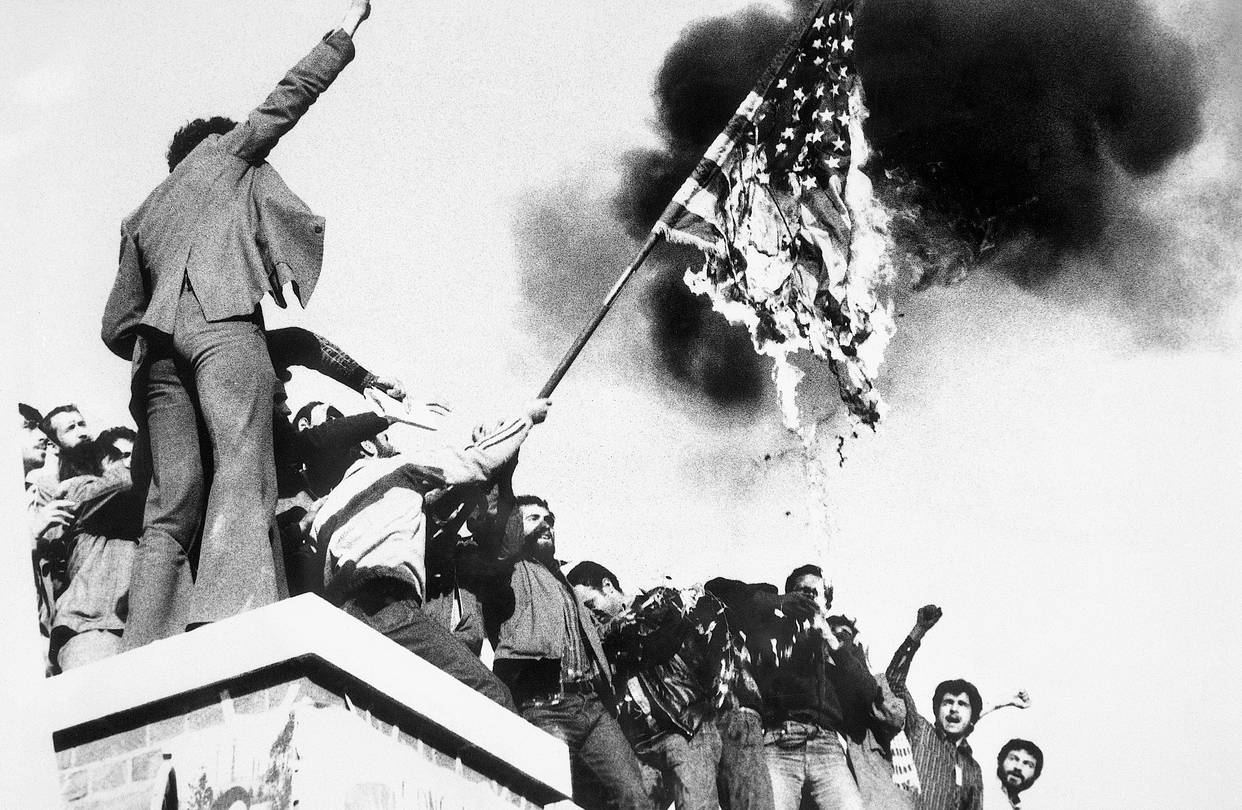
The heavy suppression of the left under the Shah’s brutal SAVAK created an opening for the organized forces of this national bourgeois-clerical aristocratic fusion to exercise leadership over the mass movement, contending with the collapsing comprador power of the Shah. While it is true these forces were opposed to western imperialism at a certain stage (particularly as they consolidated power over the revolution and, rather cynically, used the hostage crisis to advance third-world populist articulations of anti-imperialism as opposed to the communists9), they were equally, if not initially more so opposed to communism and Soviet social-imperialism, considering all communist forces to be representatives of soviet interest and, further, class enemies in general regardless of the character of the USSR or these movement’s attitudes towards it. All communism and organized working class forces were therefore an enemy to be defeated. The Islamic Revolution deftly navigated the political vacuum that existed in the collapse of the Shah regime and ideological confusion that ensued which allowed their articulation of Third-Worldist populism to become the dominant ideological trend. This ideological force was, and arguably still is at the moment, more influential in many ways than the mobilized lumpen social forces that wielded the club and bayonet against the opposition. As a result, the revolutionary proletariat within the country was brutally crushed after the revolution, advancing the same reactionary situation that prevailed under the Shah regime. Schools and universities were purged of radicals or closed outright; unions and Shoras (Iranian worker’s councils) were smashed. The communists, many of which had been making heroic sacrifices in a protracted armed struggle against the Shah, were surrounded, rounded up and executed or imprisoned en mass as the national bourgeoisie consolidated its power atop the bodies of the oppressed Iranian masses. This period could be described as a cultural counter-revolution in which the the forces of the proletariat, and liberals alike, were decisively split and smashed by the Khomeinists.
Built upon the bones of the Shah’s regime, which completed bourgeois land reforms, transforming the feudal classes into an agrarian proletariat and bourgeoisie and establishing the corresponding state structures, the Islamic Revolution vastly expanded the state bureaucracy into every facet of social life, consolidating the popular classes around the new state. The slogan of the Islamic Republican movement was "neither west nor east but Islam!" reminiscent of fascist 'third-way' slogans. It was, and principally is, a fascist-bourgeois project with theocratic ideological underpinnings. What resulted from the defeat of the Iranian proletariat was the establishment of a firmly non-aligned bourgeois-fascist state with superficial semi-feudal survivals. But due to its foundational opposition to the Israeli occupation of Palestine and (eventually) US-led imperialism, it served as a middling, albeit inconsistent (and often treacherous) ally to the Palestinian revolutionary cause and the international left and its organizations; giving more oxygen to third world populist opportunism than any genuinely revolutionary struggles.
In the intervening years since the Islamic revolution, Iran has undergone nominal democratic reforms due to the continuing struggle of the Iranian proletariat against the national bourgeoisie, comprador bourgeoisie and landlords. In fact, every year of the last decade has seen worker led struggle erupt across the provinces. But even with these reforms and the growing influence of liberal reformists, though recently diminished in light of the war, characteristic features of fascism are still firmly entrenched. The corporativism of Iranian capitalism is seen in the setting up of the state around the representatives of the different industries and guilds, such as the bonyads, so-called charitable societies which are essentially cartels that hold the monopoly on 20% of Iranian capital outside of the state run oil industry.10 These are principally organs of finance-capital under the control of the clerical-bourgeois dictatorship and answerable only to the Supreme Leader. They include the IRGC (itself an immense economic and political force), the civil services, the pharmaceutical industry, telecommunications, agriculture, construction, heavy and light industries, various clerics, and the Supreme Leader himself who holds commanding shares in every industry. The corporativism of these bonyads imply the negation of parliamentarism and the fusion of the state with the class of finance-capitalists, such as they are. These features are the characteristics of fascism which is not simply the “manifest brutality of the repressive state apparatus in the hands of the most reactionary elements of finance-capital.” Rather, the arch reaction of fascism can only be understood as the tendencies emerging out of the needs of finance-capital, which alter the state structures to maintain their accumulation regime against its capitalism’s crisis and class struggle.11
These conglomerates exploit their people for the benefit of the Iranian ruling classes and sections of the international bourgeoisie. They are beneficiaries of the sanctions regime that acts as a massive wealth transfer from the Iranian masses, who suffer both for the enrichment of world imperialism and the domestic ruling classes. It is clear that, taken in isolation, Iran is not a progressive force in relation to the Iranian people, but we do not take things in isolation.
The Kuomintang in China was not a progressive force in relation to the Chinese masses, but in the circumstances of the Japanese invasion and occupation, it became a progressive force when it joined the united front with the Communist Party in the patriotic Anti-Japanese War of Resistance. When Japanese imperialism was defeated, the progressive character of the Kuomintang ceased and the civil war for the new democratic revolution resumed. The Iranian state is a temporary progressive force in relation to the Israeli occupation and genocide of Palestine as well as the rabid imperialism of the US.But at such time when the current conflict finds resolution, should the war of national defense succeed, the principal contradiction in Iran once again becomes that between the proletariat and bourgeoisie who will undoubtedly find themselves within changed conditions with new sets of contradictions.
It is because the Iranian people are rooted in the idea of national independence that they are united in defiance of the brutal US-Israeli aggression, which has unleashed immense violence mainly against the masses, not simply the state; seeking to destroy the basic fabric of social life. The brave people of Iran can not be fooled by the forces that speak of their liberation while launching genocidal warfare against the whole nation. It is for this reason that the liberal Iranian class fractions aligned with the US-Israeli interests are unable to build sufficient mass support for a pro-western political revolution.
We should not mistake the temporary situation of unity that exists in this patriotic war of resistance as mass unity with the bourgeois state itself, though it cannot be ignored that this war of aggression has certainly consolidated large sections of the masses around the state that were middling or oppositional before, raising the popularity of the Islamic Revolution and extending its influence abroad. It is required that the international proletarian movement engage in more and better investigation of the concrete situation and build unity with the nascent proletarian forces of Iran. Further, we can not make the egregious error characteristic of the distorters of Marxism to take this situation as cause to fall into one-sided campism that makes itself ridiculous by loudly claiming the Islamic Republic as the vanguard of the revolutionary world movement or a progressive force in general. It is not. Third-Worldist nationalism, multipolarism, and all other types of right-opportunism which confuse the masses into fighting against their own class interests must be struggled against with a correct proletarian-internationalist line. The people are the makers of history and the international proletariat has a duty to support the justified struggle of the Iranian proletariat against the fascist-bourgeois state when that struggle re-emerges just as it is the role of communists within imperialist nations to break the ability of their own bourgeoisie to wage war on the world; turning reactionary war into all around revolutionary struggle to win socialism.
The role of Iran in building the axis of resistance cannot be ignored. The ability for the popular front of Palestine to resist genocide in Gaza, Ansar Allah to defeat the US-backed Saudis and beat back the Yankee navy, for Hezbollah to resist Israeli advances into Lebanon, and the Iraqi Popular Mobilization Forces to strike major blows to US bases, all setting new standards for modern guerrilla and asymmetric warfare, is rooted in the strategic depth provided by the Islamic Republic allowing for high level coordination on multiple fronts. Iran's position as a US-Israeli oppositional power in the region creates a wellspring that feeds the rivers of resistance to occupation that cut through the region. The axis forces are aligned in their goals of national liberation of West Asia from US-Israeli occupation. What that may look like for the forces involved is undoubtedly different based on the class position they inhabit. Though this alignment is very strong at the current stage and rooted in the ability of such a national base to exist in Iran, it must be understood that these movements themselves are ideologically and politically diverse, consisting of national bourgeois, petty-bourgeois, and proletarian elements. The Axis of resistance is a broad popular front against occupation led in the main by national bourgeois, and petty-bourgeois forces. These forces have in the intervening years become increasingly linked with Chinese and Russian imperialism which have supplied them with capital, weapons, technology exchange, and commodities in a trade for oil, the fruits of capital investment, and strategic cooperation on logistical and military fronts. This has helped facilitate the growth of nascent comprador elements within the state. These facts make the movement vulnerable to internal betrayal due to the concessionary nature of these classes. Their links to the Chinese and Russian bourgeoisie (and others) as well as their desire to emerge from this conflict as a fledgling imperialist power in their own right contains the distinct potential for capitulation on key issues for the West Asian and international proletariat. That being accounted for, the existential nature of their current struggles have kept certain popular demands central, class interests relatively aligned, and sustained these movements and the masses that support them, as far as they do, up to this point.
We must soberly accept that bourgeois projects, no matter how fiercely they oppose the US and Israel, or any other historic force of reaction, are themselves reactionary in the general historical sense and incapable of carrying forward the project of the oppressed masses to its completion. Only social revolution led by the proletariat is capable of overcoming the problems of capitalism-imperialism and colonialism. At best, the colonial bourgeoisie can establish a strong semi-independent bourgeois-national state capable of building the defensive structures that are required for survival, just as these defensive structures are required for the construction of socialism led by the proletariat under the guns of world imperialism. But what they cannot do is liberate the proletariat and oppressed people of the world as the bourgeois national project requires their exploitation and the continuation of world imperialism—hence colonialism— in order to survive as a class.
As far as the fighting itself, Iran and the Axis of Resistance have learned under decades of military and economic pressure what tactics and weapons are most effective at fighting against the big imperialist powers and their running dogs. Due to decades of sanctions-imposed limitations and their original, non-aligned nature, national industry has been greatly emphasized to limit external reliance on the imperialist nations, though this has changed somewhat in the last few decades with the development of finance capital in China and Russia. These domestic industries include defense, fossil fuel & chemicals, heavy industry, and logistics among others. Rather than expensive air power, cheap drones and advanced missiles are favored. Rather than the reliance on air defenses Iran has emphasized impressive bomb-resistant concrete technology and vast tunnel networks. Instead of a top heavy command structures the entire Axis of Resistance has adopted centralized-decentralization within their fighting forces allowing for heavy blows to be suffered without losing operational cohesion. All these were lessons learned from hard struggles with grievous losses over decades. In every sense, the Islamic republic has developed an army for fighting sustained guerrilla wars against US imperialism, having been taught by decades of observation and hard blows suffered.
The strategic advantage given by the Straight of Hormuz is critical. It allows for easy control of the conflict escalation ladder that can sustain the war of attrition strategy necessary to inflict pain on the US and world imperialism, especially the bureaucrat-regimes of the Gulf Cooperation Council (GCC)— one key source of the dollar's strength! Even the threat of a few sea-mines can stop 20% of the world fossil fuel industry in moments. This acts as a powerful deterrent and counter-sanction to the US’s strategy of indiscriminate, overwhelming force. The tiger caught in a bramble bush deepens his peril with every powerful swipe and is wary of feeling the sting again if he gets out!
This is one key reason why the US has until now avoided this final pillar of their plans for toppling the cold war holdouts in West Asia. The risk of trying to take on Iran was deemed too high to accept. That they now try is not as simple as Trump's personal weakness or Israeli influence over Washington. Rather, It shows us how desperate the US has become to wrest control of the world imperialism back from from the brink as nothing of this scale could be executed at the behest of a few depraved madmen. A fool's errand as such can only take flight with the support of a sizable portion the US bourgeoisie. We can see this in the comment of J.P. Morgan CEO, Jamie Dimon, who was unsure if the war would be a "tipping point" that pushes the U.S. into a recession, (a boon for the vultures of finance capital), but said "what's more important to the future of the world is that the war is successfully concluded."12
The gulf states are all whimpering and fuming on the sidelines. They have taken heavy blows to their industries and have seen that the protection racket they’ve been paying into is backed by more of a bean-curd tiger than an iron tiger. They are fearful of their own working masses who despise the US occupation and fascist regimes of the GCC states, and are taking extraordinary steps to suppress the potential of a second Arab Spring. The entire prevailing order is being tested to its foundations!
Hungry People Don't Stay Hungry for Long
The simmering ire of the oppressed Arab masses of the GCC states will inevitably erupt onto the world stage once again, as will that of the masses of the oppressed and imperialist nations. The international proletariat must work tirelessly to rebuild the tools necessary to channel these spontaneous eruptions into concrete victories over the fascist bourgeoisie and their thralls. Doing this requires we take up the sharp knife of Marxism-Leninism-Maoism, cut away the rot offered up to us by the distorters of Marxism, and rectify the general line of the communist movement to unite the broad masses behind a reconstituted Communist Party. To take seriously the task of making revolutions means taking seriously the analysis of capitalism-imperialism at the level of great-power conflict all the way down to neighborhood struggles. It will not do to know a great deal about the world but nothing about local struggles, nor is it sufficient to be a town historian without any idea of the wide-world. Our analysis is the basis of our battle plans and therefore must be as broad-minded as possible, while maintaining a focused, sober perspective immune to the intoxicating deluge of social media engagement farming and bourgeois obscurantism.
To begin with, we insist that as it relates to this war on Iran and West Asia broadly, the task of the communists is to unite all that can be united in opposition to US-imperialism in general, and uniting the advanced masses into new organs of anti-imperialist struggle in particular. Within imperialist nations the task of communists is to oppose the wars and schemes of their own bourgeoisie, and conduct agitation and propaganda among the masses of their own countries in support of the Iranian masses and the Axis of Resistance’s justified armed struggle as a necessary step towards preparing their own stage of people’s war. They must work to develop anti-imperialist mass organizations that weaken the ability of the US (as well as their own bourgeoisie in other imperialist nations) to project its power across the world and prepare the masses for revolutionary advances at home. In so doing, communists within the imperialist nations must not fall into a crude campism that collapses the contradictions within Iranian society down to the level of uncritical support for the clerical-bourgeois state of the Islamic Revolution; that a tactical unity must not be elevated to the level of strategic orientation (or worse, a total evacuation of Marxism for Third-Worldist populism), and that the stage of tactical unity with the Islamic Republic has a distinct expiration date when the principal contradiction shifts from that between US imperialism and the Iranian people back to the Iranian proletariat vs the clerical-fascist bourgeoisie. At such a time only shameful distorters of Marxism and rank opportunists will continue to uphold the Islamic Republic uncritically. Rather, communists within the imperialists nations must engage in a sober analysis of Iranian society and world imperialism, build mass organizations of anti-imperialist struggle based on a minimum anti-revisionist program, and build connections, to what degree currently possible, with the nascent forces of the Iranian proletariat towards the development of international communist organs.
Within Iran, the task of communists to unite all that can be united against US-Israeli aggression differs in that they must make tactical alliances directly with the clerical-bourgeois state and work heroically among the masses being mobilized by it in defense of their homeland, while maintaining independence from the forces of the ruling classes and pro-western liberal opposition. Due to the difficulty of open work within the conditions of war, and the repression of anything that could be deemed alliance with US-Israeli imperialism, communists will likely need to engage with the broad masses to promote expanded democratic rights and social freedoms in service of the patriotic war effort which can force a larger opening through which to organize during and after the immediate period, while keeping liberal opportunists isolated. This may take the form of promoting local defense committees and worker’s councils, as well as women’s and oppressed nation’s committees for defense of the homeland. What is possible within the current Iranian context will be best known and taken up by communists within the existing struggle—which further highlights the need for communists of both oppressed nations and imperialist states to build stronger connections with genuine communist and progressive forces in Iran to learn from their struggle and engage in higher levels of strategic coordination.
In regards to the pressing task of building genuinely anti-imperialist mass organizations within the belly of the beast, we put forward the following provisional principles as the basis for the development of a minimum program:
Self determination: Uphold the right of nations to self-determination, up to and including secession; this is what it means to allow nations to determine their own destiny in a real sense. Full support must be provided for the liberation struggles of all oppressed people against imperialist aggression, occupation, and colonization, or any schemes by which oppressed nations are made into proxy-forces in inter-imperialist conflicts.
Revolutionary Defeatism: Imperialist wars must be opposed by revolutionary struggle. Our allegiance must be placed with the oppressed peoples of the whole world, and active support must be provided for national liberation struggles against world imperialism. In addition, the argument that imperialist wars must be supported for “national security” or the benefit of US (and other imperialist nations) ‘citizens’ above others must be rejected as outright fascist demagoguery. Through agitation and exposure the proletariat of the imperialist nations must be shown that the defeat of their own bourgeoisie is in their class interest. Opportunist, reformist, and revisionist misleaders that promise a softer, kinder imperialism (quieter drone strike campaigns, and regime change operations that won’t disturb brunch!) must be vehemently struggled against. Our work must expose them as nothing but liberal phrasemongers who only open their mouths in order to paper over the fascist reality of the US imperial state so as to lull the masses back into the stupor of labor-aristocratic, petty-bourgeois dreams while imperialism goes on devouring the world.
Proletarian Leadership: Leadership over mass struggles must be exercised by the proletariat through the development of its own class-independent organizations. Multiple forces must be built and brought into coordination with each other in order to carry forward this task. These are; (1) the revolutionary party of the proletariat; (2) the united front of the popular masses and the mass organizations which cohere it; (3) and the fighting forces of the people. At each stage of development these forces must struggle to keep the proletarian political line of revolutionary movement building in command and not be swayed into movementism that tails behind the spontaneous outbursts of the masses, commandism that leaps ahead of the current stage of struggle, electoralism, or any other petty-bourgeois, social democratic “theory of change” that emphasizes liberal reformism or the terroristic conspiracies of the ultra-left.
Proletarian Internationalism: Workers and the oppressed peoples of the world must work and struggle together in their common cause to fulfill the historical task of defeating capitalism-imperialism once and for all. To have any legitimacy at all, anti-imperialist organizations must commit to developing the unity of proletarian struggles world-wide. This necessarily includes the struggles of oppressed nations and peoples within imperialist nations, not just those struggles between distinct states. Our task must be to unite the masses to mobilize against imperialism here and around the world; to advance new democratic revolutions in the oppressed nations and socialist revolution within the imperialist nations.
These four principles are forwarded as an invitation to adapt them to the development of new fighting anti-imperialist mass organizations, and are not to be taken as rigid prescriptions that must be communicated to the masses in the presented language. Rather, it is meant to serve as a skeletal form for developing the basic tenets of an anti-imperialism that do not give way to liberal ‘anti-war” or revisionist campist political lines but can serve as a unifying center that is both understandable and mobilizing for the popular masses.
Cast Off All Illusions. Prepare for Struggle!
In the world today there is much yet to be decided and many struggles ahead, but what is abundantly clear is that more decisive than the weapons and leaders is the might of the Iranian, West Asian, and international masses themselves. The masses are the makers of history! Without them there is nothing! The proletarian masses must stand at the front and take up the red banner, calling the people to join the long march to liberation. The revolutionary masses are on the front lines of every struggle erupting across the world. We look to the Adivasi peoples struggling defeat the fascist forces of India’s BJP and the multinational corporations who covet indigenous land; to the profound bravery of the Palestinian masses who have offered untold numbers of martyrs in their indefatigable cause of liberation; to the toilers of Argentina building their struggle against the despicable comprador Milei; to the strikers of Bolivia and Kenya; to the brave fighters of the New People's Army of the Philippines daily advancing the people’s war and New Democratic Revolution against bureaucrat-capitalism and US imperialism; to the indigenous First Nations of the Americas fighting to wrest their land back from the claws of the insatiable imperialists; to the revolutionaries of China working under hatches to retake the socialist road; and to the stirrings of the multinational proletariat of Europe and the US prison-house of nations, struggling against the tide to take up Guevara’s sword and strike mortal blows in the belly of the beast. The wretched of the earth are waking from their slumber. Once again, all under heaven is in chaos, and the conditions are excellent. The torturous road must be taken! Have trust in the masses and struggle tirelessly to build the mighty weapon of revolutionary proletarian organization!
Victory to the Iranian Masses!
Death to Zionism and Yankee imperialism!
Workers and oppressed peoples of the world, unite!
1. US Bureau of Transportation Statistics, “China- Total Holdings of US Treasury Bonds”.
2. Chaung, “Red Dust: The Transition to Capitalism in China”.
3. Mao Zedong, “Talk With the American Correspondent Anna Loiuse Strong”.
4. Mao Zedong, “Cast Away Illusions, Prepare for Struggle”.
5. Turkiye Today, “14 Million Volunteers ‘Ready to Die’ for Iran, Says President”.
6. Saeed Shah, The Gaurdian, “Iran Calls on Young People to Form Human Chains Around Power Plants as Trump Deadline Looms”.
7. Stephen Losey, Air & Space Forces Magazine, “The Rescue of DUDE 44: Inside the Massive Operation to Save Two Downed Airmen In Iran”.
8. Arya Zahedi, ILL WILL, “Class Stuggle, Autonomy, and the State in Iran”.
9. Ibid.
10. Proletarian Radiance, “Beyond the Veil: A Class-Based Analysis of Modern Iran”.
11. Peru People’s Movement – Reorganization Committee, “On Fascism –Reaction All Along the Line”.
12. Oisin Mcilroy, The Independent, "JP Morgan-Chase CEO Jamie Dimon Unexpectedly Comes Out in Favor of Iran War Despite Recession Fears: ‘It Was Overdue’".